Paid vs. Payed: Understanding the Correct Past Tense of “Pay”
Understanding the nuances of English grammar, especially verb conjugations, is crucial for effective communication. The verb “pay” is a common one, but its past tense and past participle forms can be confusing.
While “paid” is the standard and widely accepted form, “payed” also exists, though its usage is much more specific. This article will comprehensively explore the difference between “paid” and “payed,” providing clear definitions, examples, and practice exercises to help you master their correct usage.
Whether you’re a student, a professional, or simply an English language enthusiast, this guide will equip you with the knowledge to confidently use these forms in your writing and speech.
Definition of “Pay,” “Paid,” and “Payed”
To understand the difference between “paid” and “payed,” it’s essential to define each term:
Pay (Present Tense)
“Pay” is a verb that means to give someone money for goods or services, or to suffer a penalty or consequence. It is a transitive verb, meaning it requires a direct object, and it is also used intransitively in some contexts.
For example, “I pay my bills every month” (transitive) and “Crime doesn’t pay” (intransitive).
Paid (Past Tense and Past Participle)
“Paid” is the most common and generally accepted past tense and past participle form of “pay.” It is used in the context of giving money, settling debts, or compensating for services. It’s applicable in almost all financial contexts and in many figurative contexts related to consequences or retribution.
For example, “I paid the cashier for my groceries” (past tense) and “I have already paid my dues” (past participle).
Payed (Past Tense and Past Participle)
“Payed” is an alternative past tense and past participle of “pay,” but its usage is limited to specific nautical contexts, particularly involving ropes or cables. It means to let out (a rope or cable) slowly.
For example, “The sailors payed out the anchor cable” (past tense) and “The rope has been payed out to its full length” (past participle).
Structural Breakdown
Understanding the structural elements of these verb forms involves looking at their conjugation and how they fit into sentences.
Regular vs. Irregular Verbs
While “pay” might seem like a regular verb (where you add “-ed” to form the past tense), its primary past tense form, “paid,” is irregular. This means it doesn’t follow the standard “-ed” rule.
“Payed,” on the other hand, adheres to the regular verb conjugation, but only in its specific nautical context.
Sentence Structure
Both “paid” and “payed” function as verbs within sentences. The key is to ensure they agree with the subject and the tense of the sentence.
In sentences using “paid,” the structure typically involves a subject, the verb “paid,” and an object (the thing being paid for or the person being paid). In sentences using “payed,” the structure usually involves a subject (often sailors or a ship), the verb “payed,” and an object (the rope or cable being let out).
Types and Categories of Usage
The usage of “paid” and “payed” can be categorized based on context:
“Paid” – Financial and General Contexts
This category covers situations involving money, debts, services, and figurative uses relating to consequences.
“Payed” – Nautical Contexts
This category is strictly limited to nautical situations involving the letting out of ropes or cables.
Examples of “Paid” and “Payed”
The following examples illustrate the correct usage of “paid” and “payed” in various contexts.
Examples of “Paid”
The following table provides examples of “paid” used in financial and general contexts. Notice how it covers a wide range of situations, from simple transactions to more abstract concepts.
| Sentence | Context |
|---|---|
| I paid the bill online. | Financial transaction |
| She paid her dues to the club. | Membership fee |
| He paid the price for his mistakes. | Figurative (consequences) |
| They paid a visit to their grandparents. | Figurative (giving something) |
| We paid attention to the speaker. | Figurative (giving attention) |
| The company paid its employees on time. | Payroll |
| I paid for the groceries at the checkout. | Retail transaction |
| She paid him a compliment. | Figurative (giving a compliment) |
| He paid dearly for his arrogance. | Figurative (suffering consequences) |
| They paid their respects at the funeral. | Figurative (showing respect) |
| The ransom was paid, but the hostage was not released. | Kidnapping scenario |
| She paid the taxi driver before getting out of the car. | Transportation fare |
| He paid off his mortgage after 20 years. | Debt repayment |
| They paid a heavy price for their victory. | Figurative (sacrifices made) |
| We paid close attention to the instructions. | Figurative (focusing attention) |
| The insurance company paid out the claim. | Insurance settlement |
| I paid extra for expedited shipping. | Additional cost |
| She paid her respects to the deceased. | Mourning ritual |
| He paid the ultimate sacrifice for his country. | Figurative (death in service) |
| They paid a fortune for the antique. | Expensive purchase |
| The government paid for the new infrastructure project. | Public funding |
| She paid the penalty for breaking the law. | Legal consequence |
| He paid his last respects to his mentor. | Final farewell |
Examples of “Payed”
The following table provides examples of “payed” used in nautical contexts. Notice the specific focus on letting out ropes or cables.
| Sentence | Context |
|---|---|
| The sailors payed out the anchor cable. | Anchoring a ship |
| They payed the mooring lines to adjust the boat’s position. | Securing a boat |
| He payed the rope slowly to lower the sail. | Sailing |
| The captain ordered the crew to payed out more line. | Giving instructions |
| As the storm raged, they payed out extra cable. | During a storm |
| The fishing boat payed out its net. | Fishing |
| The salvage crew payed out the heavy cable to lift the wreck. | Salvage operation |
| The divers payed out a guideline from the boat to the underwater structure. | Diving |
| The research vessel payed out a sensor cable to measure ocean currents. | Oceanography research |
| The team payed out the tow line to the disabled vessel. | Towing |
| The bridge builders payed out the suspension cables across the river. | Bridge construction (nautical context of cable deployment) |
| The engineers payed out the communication cable to the underwater drone. | Underwater drone operation |
| The survey ship payed out the seismic cable to map the ocean floor. | Seismic surveying |
| The submarine payed out a tether for communication. | Submarine operation |
| The hot air balloonists payed out a rope to measure altitude over the sea. | Ballooning (indirect nautical context, measurement over water) |
| The oil rig workers payed out a cable to lower equipment to the seabed. | Offshore oil drilling |
| The coast guard payed out a lifeline to the stranded swimmer. | Rescue operation |
| The explorers payed out a rope while traversing a narrow sea cliff path. | Exploration (near the sea) |
Examples with Both “Paid” and “Payed” in Context
These examples demonstrate how both words can be used, highlighting the difference in meaning.
| Sentence | Context |
|---|---|
| He paid the captain, who then payed out the anchor cable. | Financial transaction followed by nautical action |
| After the company paid its debts, the sailors payed out the mooring lines. | Financial obligation and nautical task |
| She paid for the fishing rod, and then the crew payed out the fishing net. | Purchase of equipment followed by nautical action |
| The city paid for the new harbor construction, while the workers payed out the cables for the docks. | Municipal expense and nautical construction |
| The rescue team paid the salvage company, who then payed out the lines to raise the sunken vessel. | Payment and salvage operation |
Usage Rules
Here are the key rules to remember when using “paid” and “payed”:
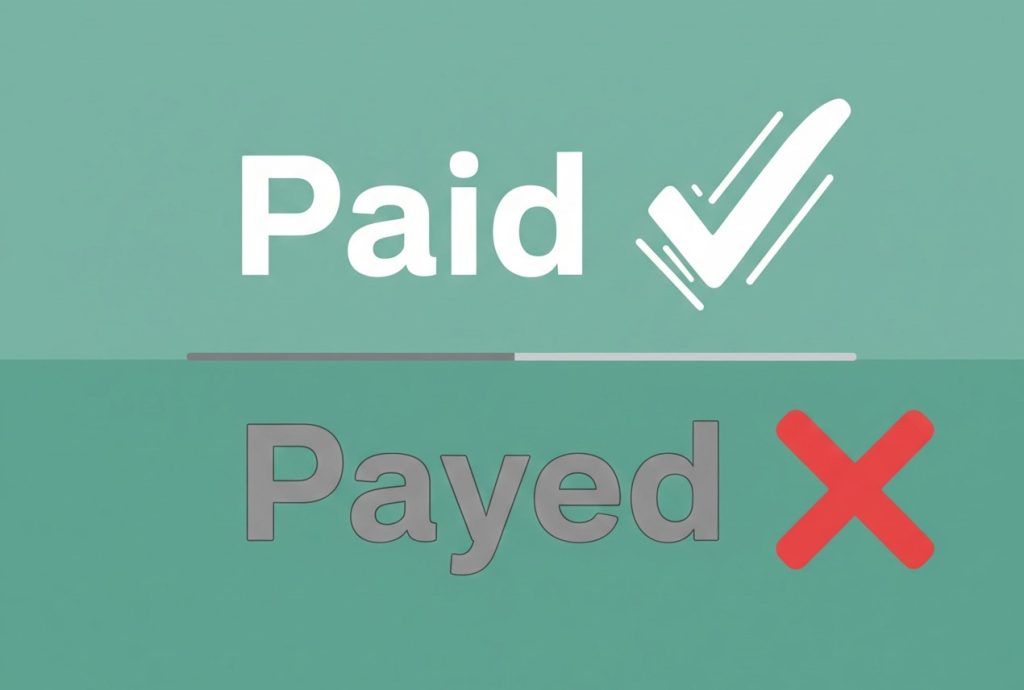
- Use “paid” for all contexts involving money, debts, services, and figurative uses related to consequences.
- Use “payed” specifically and exclusively in nautical contexts when referring to the act of letting out ropes or cables.
- When in doubt, “paid” is almost always the correct choice, especially in modern English.
Common Mistakes
One of the most common mistakes is using “payed” in non-nautical contexts. Here are some examples of incorrect and correct usage:
| Incorrect | Correct | Explanation |
|---|---|---|
| I payed the bill yesterday. | I paid the bill yesterday. | “Paid” is the correct form for financial transactions. |
| She payed her respects at the ceremony. | She paid her respects at the ceremony. | “Paid” is correct in this figurative context. |
| He paid out the anchor cable. | He payed out the anchor cable. | “Payed” is the correct nautical term. |
Practice Exercises
Test your understanding with these practice exercises. Choose the correct form, “paid” or “payed,” for each sentence.
Exercise 1
| Question | Answer |
|---|---|
| 1. I ______ the cashier for my coffee. | paid |
| 2. The sailors ______ out the mooring lines. | payed |
| 3. She ______ dearly for her mistake. | paid |
| 4. They ______ their respects to the deceased. | paid |
| 5. The crew ______ out the fishing net. | payed |
| 6. He ______ the price for his ambition. | paid |
| 7. The ship ______ out more cable in the storm. | payed |
| 8. I ______ my taxes on time this year. | paid |
| 9. The engineers ______ out the sensor cable. | payed |
| 10. She ______ him a compliment on his work. | paid |
Exercise 2: Fill in the Blanks
| Question | Answer |
|---|---|
| 1. After he ______ off his student loans, he felt a great sense of relief. | paid |
| 2. The captain ordered that the anchor be ______. | payed |
| 3. The company ______ a bonus to all its employees this year. | paid |
| 4. The rescuers ______ out a rope to reach the stranded climber. | payed |
| 5. She ______ attention in class and got good grades. | paid |
| 6. The divers ______ out the guideline to navigate the wreck. | payed |
| 7. He ______ the price, even though he was innocent. | paid |
| 8. The research team ______ out the deep-sea probe. | payed |
| 9. I ______ for the concert tickets last week. | paid |
| 10. The salvage crew ______ out the cables to lift the sunken treasure. | payed |
Exercise 3: Correct the Sentence
Identify and correct any incorrect use of “paid” or “payed” in the following sentences.
| Question | Answer |
|---|---|
| 1. I payed my dues to the organization. | I paid my dues to the organization. |
| 2. The sailors paid out the anchor cable. | The sailors payed out the anchor cable. |
| 3. She paid dearly for her mistake, but the ship payed out the rope safely. | She paid dearly for her mistake, but the ship payed out the rope safely. |
| 4. He payed the price for his arrogance. | He paid the price for his arrogance. |
| 5. The fisherman paid out the net into the sea. | The fisherman payed out the net into the sea. |
| 6. After he payed his taxes, he felt relieved. | After he paid his taxes, he felt relieved. |
| 7. The climbers carefully paid out the rope. | The climbers carefully payed out the rope. |
| 8. She paid attention to the lecture and took notes. | She paid attention to the lecture and took notes. |
| 9. The team payed the salvage company for their services. | The team paid the salvage company for their services. |
| 10. The workers paid out the communication cable. | The workers payed out the communication cable. |
Advanced Topics
For advanced learners, it’s useful to consider the historical context and less common usages of “payed.”
Historical Usage
Historically, “payed” was more commonly used in a broader range of contexts, but its usage has significantly narrowed over time. Modern English overwhelmingly favors “paid” for most situations.
Figurative Nautical Usage
In rare instances, “payed” might be used figuratively to describe a gradual release or extension of something, drawing on its nautical origin. However, this is highly uncommon and should be approached with caution.
Frequently Asked Questions
Here are some frequently asked questions about “paid” and “payed”:
Is “payed” ever correct?
Yes, “payed” is correct in nautical contexts when referring to letting out ropes or cables. However, this is its only accepted usage in modern English.
Can I use “payed” in financial contexts?
No, you should always use “paid” in financial contexts. “Payed” would be considered incorrect in such situations.
What’s the past participle of “pay”?
The past participle of “pay” is “paid” in most contexts. In the specific nautical context, “payed” can also function as a past participle.
Is “payed out” a common phrase?
“Payed out” is a relatively common phrase within nautical circles, referring to the action of releasing or extending a rope or cable. Outside of this context, it’s rarely used.
Why does “pay” have two different past tense forms?
The existence of two forms reflects the evolution of the English language. “Paid” became the dominant form for general usage, while “payed” retained its specific nautical meaning.
If I’m unsure, should I use “paid” or “payed”?
When in doubt, always use “paid.” It is the universally accepted form for the vast majority of situations.
Are there any regional differences in the usage of “paid” and “payed”?
No, the usage of “paid” and “payed” is consistent across different English-speaking regions. The distinction lies in the context, not the location.
Can “payed” be used metaphorically outside of nautical contexts?
While technically possible, using “payed” metaphorically outside of nautical contexts is highly unusual and might sound awkward or incorrect to most native English speakers. It’s best to avoid it.
Conclusion
Understanding the difference between “paid” and “payed” is crucial for accurate and effective communication. While “paid” serves as the standard past tense and past participle form of “pay” in almost all contexts, “payed” maintains its specific usage in nautical settings related to ropes and cables.
By mastering these distinctions, you can confidently navigate the nuances of English grammar and avoid common errors. Remember to prioritize “paid” in general usage and reserve “payed” for its designated nautical applications.
With practice and attention to detail, you can ensure your writing and speech are clear, precise, and grammatically sound.